Wildlands
Since the earliest days of colonial settlement, Maryland has been described as a land of natural beauty. Situated on the border between temperate and tropical climes, with access to both salt and fresh waters, the State offers a unique diversity in topography and biology.
Barn Spider (Neoscona crucifera), Baltimore, Maryland, September 2016. Photo by Sarah A. Hanks.
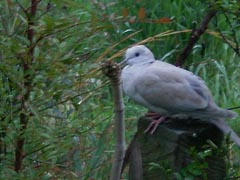 Wildlife and Heritage Service of the Department of Natural Resources oversees Wildlife Management Areas. These 61 protected areas total 123,530 acres, and may offer limited recreational activities.
Eurasian Collared-Dove (Streptopelia decaocto), Glen Burnie, Maryland, April 2011. Photo by Diane F. Evartt.
![[photo, Eastern Snapping Turtle (Chelydra s. serpentina), Annapolis, Maryland]](/msa/mdmanual/01glance/wildlife/reptiles/images/1198-1-5957a.jpg) Fishing and Boating Services of the Department of Natural Resources manages Maryland's Fishery Management Areas. These 1,159 acres include State hatcheries as well as public areas for fishing and boating.
Fishing and Boating Services of the Department of Natural Resources manages Maryland's Fishery Management Areas. These 1,159 acres include State hatcheries as well as public areas for fishing and boating.
Eastern Snapping Turtle (Chelydra s. serpentina), Annapolis, Maryland, May 2012. Photo by Diane F. Evartt.
![[photo, Catalpa sphinx caterpillar, Glen Burnie, Maryland]](/msa/mdmanual/01glance/wildlife/insects/images/1198-1-06610
b.jpg) Countless different species* may be observed in Maryland's natural areas, and are divided by numerous physical features. The most abundant families are amphibia (amphibians); arthropods (crustaceans, insects, & spiders); aves (birds); mammalia (mammals); and reptilia (reptiles). Often, they are classified further by diet, as carnivores, herbivores, and omnivores, although this division can be narrowed to define specific dietary habits, such as insectivores.
Countless different species* may be observed in Maryland's natural areas, and are divided by numerous physical features. The most abundant families are amphibia (amphibians); arthropods (crustaceans, insects, & spiders); aves (birds); mammalia (mammals); and reptilia (reptiles). Often, they are classified further by diet, as carnivores, herbivores, and omnivores, although this division can be narrowed to define specific dietary habits, such as insectivores.
*(specific animals are classified by eight main taxonomic ranks: domain; kingdom; phylum; class; order; family; genus; and species)
Catalpa sphinx caterpillar, Glen Burnie, Maryland, September 2014. Photo by Diane F. Evartt.
![[photo, Eastern Box Turtle (Terrapene c. carolina), Glen Burnie, Maryland]](/msa/mdmanual/01glance/wildlife/reptiles/images/1198-1-08172b.jpg)
Maryland maintains nearly forty thousand acres of wildlands, which are encompassed by State parks, forests, and wildlife management areas. These areas allow for Maryland's natural wildlife to thrive virtually undisturbed. State wildlands are protected by law, and are monitored and protected by the Natural Resources Police Force.
Eastern Box Turtle (Terrapene c. carolina), Glen Burnie, Maryland, June 2017. Photo by Diane F. Evartt.
![[photo, Mallards (Anas platyrhynchos), Glen Burnie, Annapolis, Maryland]](/msa/mdmanual/01glance/wildlife/birds/images/1198-1-08179c.jpg)
Mallards (Anas platyrhynchos), Glen Burnie, Annapolis, Maryland, July 2017. Photo by Diane F. Evartt.
![[photo, Great Blue Heron (Ardea herodias), College Creek, Annapolis, Maryland]](/msa/mdmanual/37mun/annapolis/images/1198-1-4472.jpg)
Great Blue Heron (Ardea herodias), College Creek, Annapolis, Maryland, July 2010. Photo by Diane F. Evartt.
![[photo, Carolina Mantid (Stagmomantis carolina), Baltimore, Maryland]](/msa/mdmanual/01glance/wildlife/insects/images/1198-1-07825b.jpg)
Carolina Mantid (Stagmomantis carolina), Baltimore, Maryland, September 2016. Photo by Sarah A. Hanks.
© Copyright Maryland State Archives
![[photo, White-tailed Deer (Odocoileus virginianus), Glen Burnie, Maryland]](/msa/mdmanual/01glance/wildlife/mammals/images/1198-1-07344b.jpg)
![[photo, Eastern Cottontail Rabbit (Sylvilagus floridanus) in grass with early wildflowere, Glen Burnie, Maryland]](/msa/mdmanual/01glance/wildlife/mammals/images/1198-1-08482b.jpg)
![[photo, Barn Spider (Neoscona crucifera), Baltimore, Maryland]](/msa/mdmanual/01glance/wildlife/arachnids/images/1198-1-07834b.jpg)